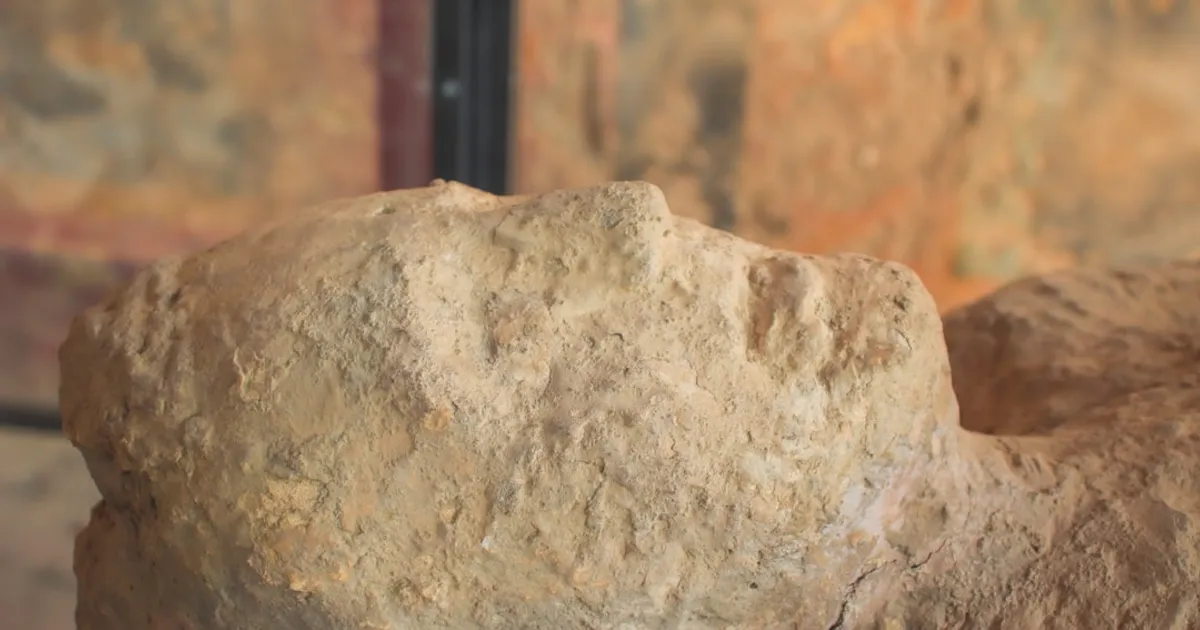
He was running for the coast when the ash caught him, a terracotta mortar held over his head like a shield against the raining pumice. Almost two thousand years later, archaeologists at Pompeii have used artificial intelligence to show us his face.
The project, a collaboration between the Pompeii Archaeological Park and the University of Padua, took skeletal measurements and archaeological data and turned them into a realistic human portrait. The result shows a man on a debris-covered road, clutching that terracotta mortar as a makeshift shield against falling volcanic stones.
The man was discovered near the Porta Stabia necropolis, just outside the ancient city walls, alongside another person. Both were trying to flee toward the coast. He died early in the disaster, during the heavy fall of volcanic debris. His personal effects were found with him: an oil lamp, a small iron ring, and ten bronze coins. The terracotta mortar matches accounts from Pliny the Younger, who described residents grabbing whatever they could to protect themselves from the ash and pumice raining down.
Park director Gabriel Zuchtriegel said in a statement that "the vastness of archaeological data is now such that only with the help of artificial intelligence will we be able to adequately protect and enhance them." He added that AI, used well, could help renew classical studies. But not everyone's sold. Commentators on tech forums raised concerns about AI hallucinations potentially distorting historical perception. Others pointed out that English-language reports didn't include the actual generated image, directing people to the Italian press release for visuals.
The specific AI tools used haven't been detailed in public reports, though facial reconstruction typically involves deep learning approaches like generative adversarial networks or 3D morphing algorithms. Modern AI frameworks rely heavily on these computational techniques to handle complex matrix operations required for deep learning. The University of Padua has a track record in forensic anthropology and digital restoration, so they're not newcomers here. But making the past feel this immediate comes with responsibility. When you show someone what a dead man looked like, you'd better be right.