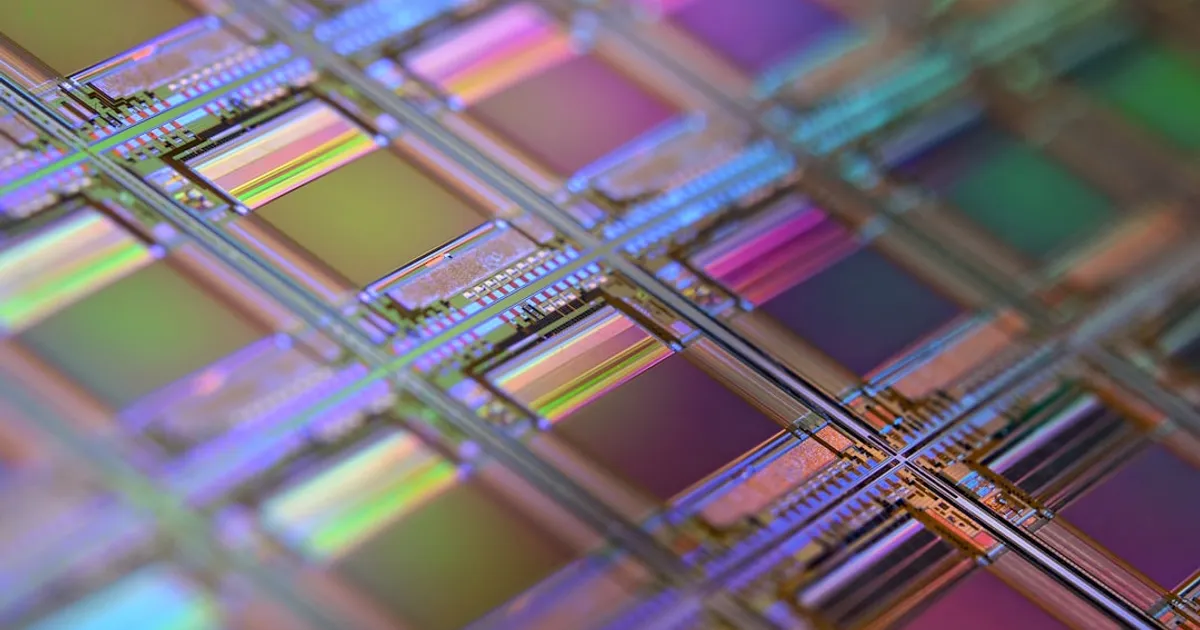
Canadian startup Taalas emerged from stealth on February 19, 2026, announcing HC1, a working silicon chip fabricated on TSMC's N6 process node that permanently encodes the entire Llama 3.1 8B model's weights into the chip's upper metal layers. By eliminating external HBM memory entirely, Taalas claims HC1 delivers 17,000 tokens per second per user at 250W with air cooling, pricing inference at 0.75 cents per million tokens — compared to 20–49 cents for GPU-based cloud inference. The company says the path from a finished model to production silicon takes approximately two months by modifying only the top two metallization layers while reusing the rest of the chip architecture. A public demonstration is available at chatjimmy.ai, and Taalas has reportedly raised $219M in total funding, including a $169M round led by Fidelity announced alongside the chip reveal.
The technical claim addresses a genuine and well-documented bottleneck in AI inference: GPUs typically spend 80–90% of their energy and time transferring model weights between external memory and compute cores. By physically fusing weights into metal, Taalas eliminates this memory wall entirely. The company's roadmap includes an HC2 chip targeting a frontier-scale model by winter 2026, alongside a broader "AI Foundry" concept where any LLM can theoretically be converted to dedicated silicon on demand. Co-founder Ljubisa Bajic previously co-founded Tenstorrent. The initial $50M seed round was led by Pierre Lamond, who also holds board-level involvement at Cerebras, a direct competitor. The ORPHEUS piece that first reported the story describes Lamond as a semiconductor veteran who helped build National Semiconductor in 1967 after working under Gordon Moore at Fairchild — a biographical detail Agent Wars has not independently verified and which should be treated as sourced to that piece only. What is verifiable: Lamond committed capital before HC1's public debut, which remains the most credible third-party technical signal the company has produced.
Cerebras uses wafer-scale compute, Groq employs a streaming LPU architecture, and SambaNova relies on reconfigurable dataflow — but all three still maintain software-addressable memory hierarchies. Taalas's hardwired-weights model trades that flexibility for extreme efficiency in a fixed-parameter deployment scenario. LoRA adapters are supported via a small on-chip SRAM block, providing a fine-tuning pathway without full chip redesign. For agent infrastructure, the pricing gap is concrete: Groq currently lists Llama 3.1 8B inference at roughly $0.05 per million tokens — already considered cheap by cloud-provider standards — putting Taalas's claimed 0.75¢ rate at approximately 7x lower still. Pair that with sub-millisecond latency and no cloud dependency, and the cost floor for always-on edge agents drops to a level where use cases currently considered uneconomical become straightforward.
Skepticism is warranted. Hacker News commentary following the announcement raised several pointed concerns: HC1 is built around Llama 3.1 8B, a relatively small and fixed-parameter dense model, and it remains undemonstrated whether the hardwired-weights approach generalizes to the dynamic, sparse mixture-of-experts architectures that define competitive frontier models in 2026. Scaling to larger models with much broader context windows presents non-trivial architectural challenges the company has not publicly addressed. The ORPHEUS piece itself acknowledges a 55–65% probability of its projected scenario playing out — speculative extrapolation, not a forecast. Some Hacker News commenters also questioned whether the coverage constitutes paid promotion. HC1's performance claims have not been independently benchmarked, and Taalas has yet to show a credible path to frontier-scale models. Until both happen, the story is interesting — not settled.